
Architecture
Explore the Ozone API Platform architecture using an AWS reference deployment, including traffic management, application hosting, scaling, and data storage.
Use this Amazon Web Services (AWS) example to understand how the Ozone API Platform handles traffic, runs applications, and stores data.
The platform is cloud-agnostic (not tied to one cloud provider): you can run it on different cloud platforms or on infrastructure your organization manages on-site. This reference deployment (an example of how to arrange the platform and its supporting services) uses AWS. You can apply the same principles using equivalent services on Azure, Google Cloud, or other platforms.
AWS reference architecture
In this example, the platform runs across three separate AWS locations, distributes incoming requests across application servers, and adjusts server capacity as demand changes. It uses supporting services to store data, manage security, and monitor activity.
Use the diagram to see how these parts connect, then read the table below for an explanation of each area.
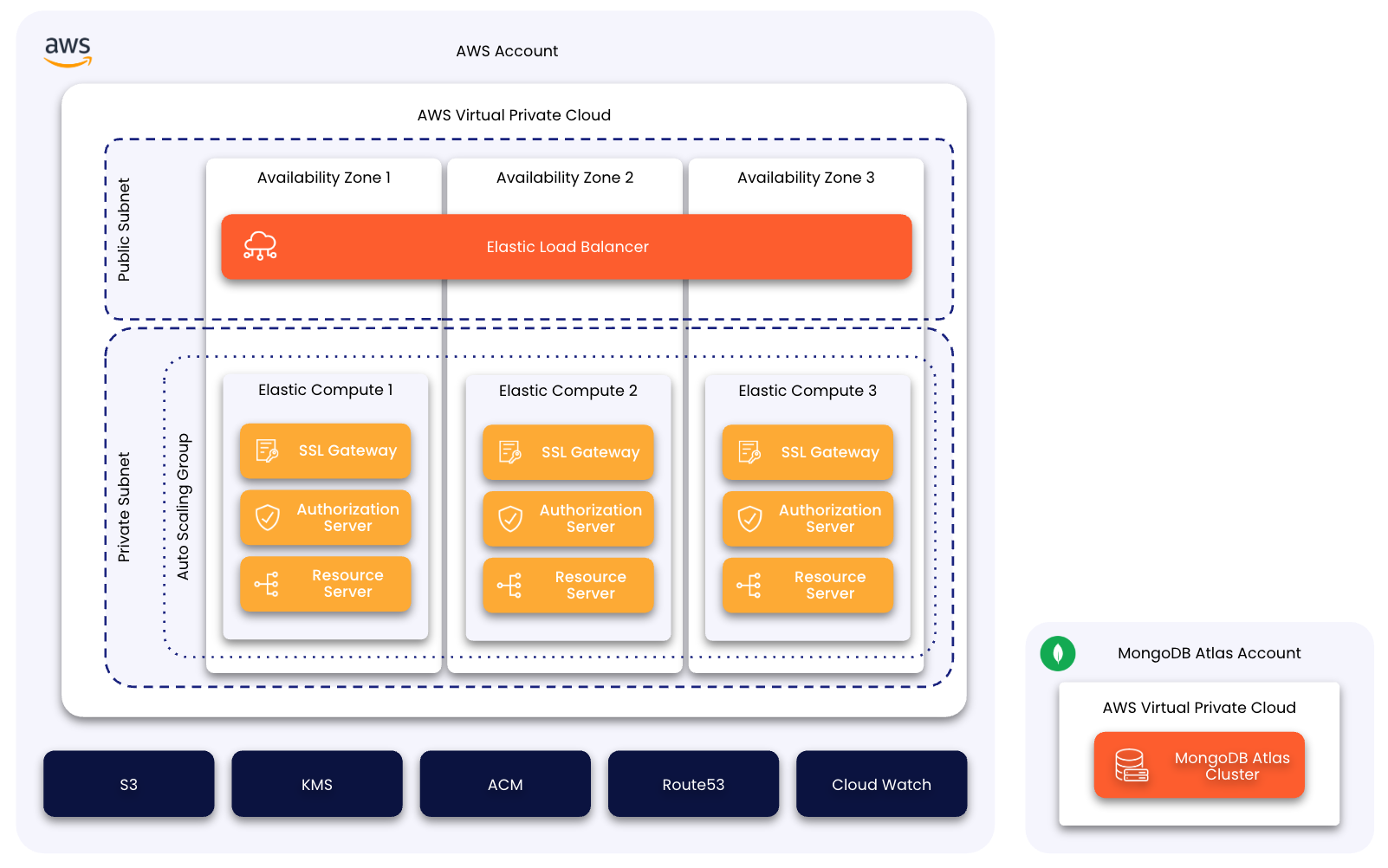
Ozone API Platform – AWS reference architecture
Architecture overview
The table explains what each part does and identifies the AWS services used in this example.
| Area | How it works in this reference deployment |
|---|---|
| High availability | To help keep the platform available during failures, it runs across three AWS Availability Zones (separate locations within an AWS region). |
| Traffic management | An Elastic Load Balancer (a service that shares incoming requests across servers) distributes traffic across application servers. It sits in a public subnet, a section of the network with a route to the internet. |
| Application hosting | Amazon Elastic Compute Cloud (EC2) instances are virtual servers. Across the Availability Zones, they run the SSL Gateway, Authorization Server, and Resource Server—the platform's application components. The SSL Gateway terminates TLS and mTLS connections; "SSL" is part of the component's name only. |
| Scaling | An Auto Scaling Group (a managed group of EC2 servers) adjusts server capacity based on demand. |
| File storage | Amazon Simple Storage Service (S3) stores files as objects. |
| Key management | AWS Key Management Service (KMS) manages encryption keys, which are used to protect data. |
| Certificate management | AWS Certificate Manager (ACM) manages digital certificates used to secure connections. |
| Domain names | Amazon Route 53 provides the Domain Name System (DNS) service, which connects domain names to network addresses. |
| Monitoring | Amazon CloudWatch monitors activity to help you understand how the platform is running. |
| Data storage | The platform connects to a MongoDB Atlas cluster (a group of servers that provides a managed database). |
Confirm your deployment architectureThis is an example, not a fixed design for every deployment. Your cloud provider and infrastructure requirements may change which services you use, where they run, and how they connect.
Confirm your deployment architecture with your Ozone delivery team.
See Deployment Options to compare where you can host the platform and who is responsible for running it.
Updated 29 days ago